Showing posts with label financial planning. Show all posts

Monday, June 27, 2011

MyVi vs Honda City Downpayment and Monthly Installment


Perodua Myvi EZ 1300cc 

On the road price for a brand new automatic, solid perodua Myvi EZ 1300cc (in Peninsular Malaysia) is RM 46900. A 20% downpayment of RM 9380 and seven year hire purchase loan with an interest rate of 4%, translate into monthly repayments of RM 571.

Model : Perodua Myvi EZ 1300cc (for peninsular Malaysia)

On the road price : RM 46900

Downpayment : RM 9380 (20%)

Period : 7 years

Monthly commitments : RM 571


Perodua Myvi EZ 1300cc - second hand

A cheaper option is a four year old second hand model, which cost about RM 35000, or RM 445 a month (assuming a 20% down payment and interest rate 4.5 %)

Model : Perodua Myvi EZ 1300cc (second hand)

On the road price : RM 35000

Downpayment : RM 7000 (20%)

Period : 7 years

Monthly commitments : RM 445


Honda City (E class)

A Honda City is the dream car for those who are in their 20s and 30s. The grade E model on the road price RM 90, 480. A downpayment of 20% and hire purchase loan of seven years at 4% translate into monthly commitments of RM 1102.99.

Model : Honda City

On the road price : RM 90,480

Downpayment : RM 18,096  (20%)

Period : 7 years

Monthly commitments : RM 1,102.99


Tuesday, June 14, 2011

How to apply IPO via online?

What does IPO means?
investopedia definition:
The first sale of stock by a private company to the public. IPOs are often issued by smaller, younger companies seeking the capital to expand, but can also be done by large privately owned companies looking to become publicly traded.

In an IPO, the issuer obtains the assistance of an underwriting firm, which helps it determine what type of security to issue (common or preferred), the best offering price and the time to bring it to market.

Also referred to as a "public offering". 

So how to apply ?


via CIMB Clicks


i take MSM example, applied on 13 June 2011

step 1


step 2


step 3


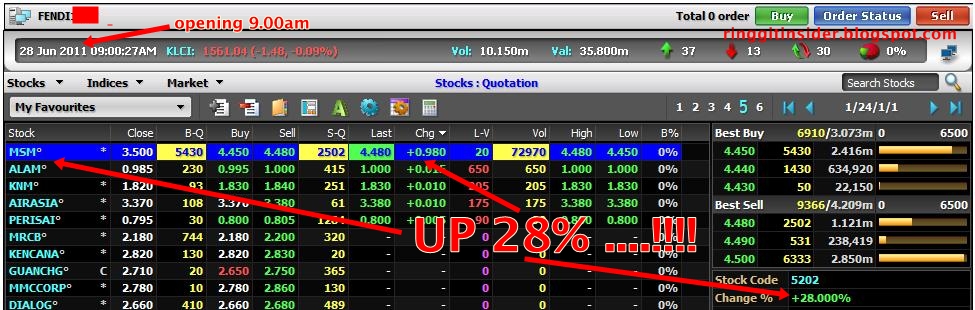
MSM IPO, let see performance on listing, 28/6/2011


let see some IPO performance in Bursa Malaysia recently:


Saturday, June 11, 2011

Car or a house first?

Alan Tong justifies putting a house before a car but admits this is only possible when a comprehensive public transportation system is in place.
AFTER you have graduated and secured your first job, what would be the first big ticket item that would appear in your purchase list? Many would think of a car before any other item.
Owning a car has become the first priority for many young people in Malaysia.
However, in China, their youths have a different thought. They would prefer to own a house instead of a car as their first asset.
This is an interesting difference in mindset between the youths in Malaysia and China.
What makes our young people decide to purchase a vehicle which will depreciate in value over the years instead of a house which has the possibility of gaining capital appreciation over time?
There are many reasons influencing this mindset. Chief amongst them is the macro development of the country and in particular of our public transportation.
Regrettably, although our current public transportation system has improved, it has not reached the level of that of a developed country.
Waiting in a queue to board a bus or train which may not arrive on time has become a hassle to many who have to depend on them for their daily transportation.
Therefore, in order to move around in the most convenient and comfortable manner, Malaysians in general have little choice but to acquire their own vehicle as their first asset.
The situation is different when compared to that in cities with a comprehensive public transportation system. Let's look at China for example. As one of the fastest growing nations in the world, China is an inspiring example for us to study.
For the past 15 years, I have been travelling frequently to China and have witnessed the vast changes in its transportation system. Its government had envisaged the need to have an efficient transportation system to support its fast paced economy and was bold enough to implement and develop a transportation network ahead of demand.
Fifteen years ago, I hardly saw vehicles throughout a 100 km journey on well constructed highways in China (and even at that time some highways came with 14 lanes). Those highways are now supporting high traffic flow with millions travelling from one province to another every day.
In addition, many cities in China are now well connected with an efficient network of public transportation.
This comprehensive public transportation service has allowed its people to travel around easily. Owning a private vehicle is therefore not a necessity but a prestige. With its people moving to the big cities for jobs or business opportunities, the priority is to own a property for accommodation or business if possible.
If not, renting a property would be the next best option.
This explains the divergence in mindset between the youths in Malaysian and those in China when it comes to the question of wheather to own a car or a house first.
To address this situation, the government should take initiatives in developing an extensive public transportation system and subsidising the relevant projects, such as the latest Mass Rapid Transit plan.


Public transportation is an avenue where the government could channel resources to good use and benefit the lower income groups as a whole. Comprehensive public transportation at affordable fares would reduce the burden of travelling, and people could consider more capital investment tools, such as properties.
Although buying a house is also a major financial decision and there are a lot of factors to be considered, proper financial planning would help our young people to start saving towards their goal of owning a property at an early age.


We look forward to the day when our local public transportation system is well established. That day will also be the day where our Malaysian youths have the foresight and drive to own a house first before anything else.
Datuk Alan Tong is the group chairman of Bukit Kiara Properties. He was the FIABCI world president from 2005 to 2006 and was recently named Property Man of The Year 2010 by FIABCI Malaysia.


Datuk Alan Tong is the group chairman of Bukit Kiara Properties. He was the FIABCI world president from 2005 to 2006 and was recently named Property Man of The Year 2010 by FIABCI Malaysia.
source: THE STAR

Wednesday, December 15, 2010

Top 10 Biggest Shariah Company in Bursa Malaysia (FBM SHARIAH)

1. SIME (RM 52.04 B)

2. MAXIS (RM 39.75 B)

3. AXIATA (RM 39.52 B)

4. IOICORP (RM 38.85 B)

5. MISC (RM 36.83 B)

6. TENAGA (TNB) (RM 36.58 B)

7. KUALA LUMPUR KEPONG (KLK) (RM 22.80 B)

8. PETRONAS GAS (RM 22.20 B)

9. PLUS (RM 22.00 B)

10.  PERLIS PLANTATION BERHAD (RM 20.22 B)

# rank by market capitalization as 15 DEC 2010

Source : BURSA MALAYSIA

Saturday, December 4, 2010

Give back, Buffet tell investors

“Warren’s first investment was when he was 11 years old. The stock that he bought was called Cities Service Preferred at US$38 a share, only to watch it sink to US$27. He sweated it out and sold it when it reached US$40, only to watch it soar to US$400 (RM1,236).
“This was his first lesson in patience, where good things do come to those who wait, provided you pick the right business.”

Contrary to merely chasing fortunes for personal gain, best-selling author, international speaker, consultant, environmental activist Mary Buffett says investors should focus on giving back to society, just as her former father-in-law Warren Buffett has pledged to do.

“Right now, top priority should be to invest in health, education, literacy and communications. Invest in individuals, families and communities. 

“As we speak, people of great wealth have pledged to give back at least 50% of their wealth back to society. Enjoy your wealth but also give what you can’t possibly spend back to society who gave you the opportunity. Philanthropy is the highest form of investment,” she said in her speech at a recent Kuala Lumpur conference entitled “Dawn of the New Decade: Alternative Investments in Asia”. 

Investors should always be patient and not chase the price of a stock as well, Buffett says, while giving the example in her former father-in-law. “Warren’s first investment was when he was 11 years old. The stock that he bought was called Cities Service Preferred at US$38 a share, only to watch it sink to US$27. He sweated it out and sold it when it reached US$40, only to watch it soar to US$400 (RM1,236).
“This was his first lesson in patience, where good things do come to those who wait, provided you pick the right business.”

She also encouraged investors to treat the companies that they invest in like their own offspring. “Warren’s investments are like children to him. He keeps a mindful, watching eye on them, knows their limits and how far to challenge them.”

This article appeared on the Personal Finance page, The Edge Financial Daily, September 30, 2010.

Saturday, November 13, 2010

Trading for dummies e-book download

Here i share with you guys an e-book. May this will help us to gain some knowledge about trading? insyaALLAH.

Friday, November 12, 2010

Tips: 7 Spending Tips From Frugal Billionaires


by Jean Folger
Carlos Slim Helu (Carlos Slim), a telecom tycoon and billionaire with well-known frugal tendencies, has a net worth of $60.6 billion, according to Forbes. Assuming no changes in his net worth, he could spend $1,150 a minute for the next 100 years before he ran out of money. To put this in perspective, he could spend in 13 minutes what a minimum-wage earner brings home after an entire year of the daily grind.


Granted, the world's billionaires (all 1,011 of them) are in the debatably enviable position of having, quite literally, more money than they can possibly spend, yet some are still living well below their means, and save money in surprising places. Even non-billionaires (currently 6,864,605,142 of us) can partake in these seven spending tips from frugal billionaires:
1. Keep Your Home Simple
Billionaires can afford to live in the most exclusive mansions imaginable -- and many do, including Bill Gates' sprawling 66,000 square foot, $147.5 million dollar mansion in Medina, Wash. -- yet frugal billionaires like Warren Buffett choose to keep it simple. Buffett still lives in the five-bedroom house in Omaha that he purchased in 1957 for $31,500. Likewise, Carlos Slim has lived in the same house for more than 40 years.
2. Use Self-Powered or Public Transportation
Thrifty billionaires including John Caudwell, David Cheriton and Chuck Feeney prefer to walk, bike or use public transportation when getting around town. Certainly these wealthy individuals could afford to take a helicopter to their lunch meetings, or ride in chauffeur-driven Bentleys, but they choose to get a little exercise and take advantage of public transportation instead. Good for the bank account and great for the environment.
3. Buy Your Clothes off the Rack
While some people, regardless of their net value, place a huge emphasis on wearing designer clothes and shoes, some frugal billionaires decide it's simply not worth the effort, or expense. You can find David Cheriton, the Stanford professor who matched Google founders Sergey Brin and Larry Page to the venture capitalists at Kleiner, Perkins, Caufield & Byers (resulting in a large reward of Google stock), wearing jeans and a t-shirt.
Ingvar Kamprad, the founder of the furniture company Ikea, avoids wearing suits, and John Caudwell, mobile phone mogul, buys his clothes off the rack instead of spending his wealth on designer clothes.
4. Keep your Scissors Sharp
The average haircut costs about $45, but people can and do spend up to $800 per cut and style. Multiply that by 8.6 (to account for a cut every six weeks) and it adds up to $7,200 per year, not including tips. These billionaires can certainly afford the most stylish haircuts, buy many cannot be bothered by the time it takes or the high price tag for the posh salons. Billionaires like John Caudwell and David Cheriton opt for cutting their own hair at home.
5. Drive a Regular Car
While billionaires like Larry Ellison (co-founder and CEO of Oracle Corporation) enjoy spending millions on cars, boats and planes, others remain low key with their vehicles of choice. Jim Walton (of the Wal-Mart clan) drives a 15-year-old pickup truck. Azim Premji, an Indian business tycoon, reportedly drives a Toyota Corolla. And Ingvar Kamprad of Ikea drives a 10-year-old Volvo. The idea is to buy a dependable car, and drive it into the ground. No need for a different car each day of the week for these frugal billionaires.
6. Skip Luxury Items
It may surprise some of us, but the world's wealthiest person, Carlos Slim (the one who could spend more than a thousand dollars a minute and not run out of money for one hundred years) does not own a yacht or a plane. (Reducing the amount you spend is the easiest way to make your money grow.)
Many other billionaires have chosen to skip these luxury items. Warren Buffett also avoids these lavish material items, stating, "Most toys are just a pain in the neck."
What We Can Learn
Some of the world's billionaires have frugal tendencies. Perhaps this thrifty nature even helped them make some of their money. Regardless, they have chosen to avoid some unnecessary spending (at least on their scale) and the 6,864,605,142 non-billionaires out there can follow suit, eliminating excessive, keep-up-with-the-Jones style spending. No matter what a person's income bracket is, most can usually find a way to cut back on frivolous spending, just like a few frugal billionaires.


Source:
http://finance.yahoo.com/

Is Your EPF Money Enough for Retirement?


ONLY 5% of Malaysians are prepared for retirement. Despite a growing awareness for the need to prepare for one’s retirement, many do not translate their plans into action.

Those in their 20s think they are too young to think about retirement, while those in their 30s and 40s tend to believe they are doing enough because they have their EPF savings. By the time they are 55, it is just too late.

The sad truth is that at 55, most people cannot retire with financial security.

Based on EPF’s 2005 annual report, about 90% of EPF contributors have less than RM100,000 in their accounts – not enough to see them through 20 years past retirement.

Let we see article below:

By Ooi Kok Hwa, as featured in The Star.

SOME studies conducted in Malaysia have shown that most retirees spend all their EPF money within three years of their retirement. Given that the average lifespan for a Malaysian is 75 years, if we retire at 55 and spend all our EPF money within three years, a lot of us will be wondering how to survive from 58 to 75.

The most worrying question that most of us will be asking is how to survive retirement when we lose our steady stream of monthly income to cover our daily expenses.

However, if we have been building an investment portfolio apart from EPF money, we would not be able to generate a source of returns from our own investment portfolio.

In reality, a lot of us have been spending most of our savings, including part of our EPF savings on our children’s education and clearing debts on house and car purchases, which leave us with not much savings for our retirement.

With this general concern in mind, let’s look into how much of our EPF money we can afford to spend to have enough for our retirement based on the our local conditions and some assumptions.

Generally, an average Malaysian starts working at 25 and reaches retirement at 55 (after 30 years of working), thereafter living the remaining 20 years (until 75) relying on the EPF savings.

We will assume a starting pay of RM1,500, growing at the rate of 8% per annum; an average bonus of two months per annum, average EPF returns of 5%, total EPF contribution of 23% (employer: 12%, employee: 11%) and inflation rate of 3%.

Our main objective is to test how much EPF money we can spend until we use it all up.

Our analysis shows that if we are able to live with just one-third (or 33%) of our last drawn salary, the EPF money should be able to support us for 20 years until we pass away at 75.

From the example below, if a person’s last drawn salary is RM13,976 at 55, he can only afford to spend one-third or RM4,612 per month after retirement (1/3 x RM13,976).

However, if his spending exceeds the one-third level, such as 50% or the full amount of his last drawn salary, his EPF money can only last 12 or five years respectively.

Even though our computations are based on a lot of assumptions and hypothetical scenarios, our objective is to bring to your attention that we need to be careful in spending our EPF money and control our expenses once we retire.

We will need to adjust our lifestyle after our retirement, especially for those of us that are used to spending most of our take-home pay when we are still working.

Once we lose the regular income source and are relying just on the savings, we will need to plan carefully in order not to out-live our savings. In this example, we can only afford to spend 33% of our last salary after retirement!

Everyone has different financial situations. However, we need to plan for our retirement. If possible, we need to build our own investment portfolio apart from the EPF savings. We may need to seek some part-time jobs after retirement if our financial resources do not permit us to stop working. Besides, we need to clear all our outstanding debts before retirement.

We also need to buy enough life and medical insurance for ourselves as well as set up education funds for our children.

Last but not least, one important point to note is that our computation is based on the assumption that we are still able to generate 5% returns after retirement.

Unless we have the skills and knowledge to generate the returns, putting the money back in EPF and letting EPF generate returns may be a good option. For the average person, we feel that it is not easy to generate 5% returns annually over a long period of time.

- Ooi Kok Hwa is an investment adviser and managing partner of MRR Consulting.

Monday, November 1, 2010

Tips to doubled your money through investment


What are the most favorite investment vehicle to doubled your money nowdays? From basic and low risk investment to the most profit and high risk instrumental, we are listing 9 ways to invest your money through various investment vehicle. check it out....

1. Amanah Saham Bumiputera (ASB)
Risk : Very low
Return : 8-10% per annum

This is the most favorite way Bumiputera invest their money. ASB is very low risk instrumental investment. It is passive investment and easy to invest. You can invest a fixed amount of your money every month through salary deduction and with the option to add or reduce the investment amount conveniently. With the maximum allowable investment at RM 200,000 a person, ASB should be your primary investment vehicle until it reach ceiling amount. This is very long term investment with comparatively high return ( average 8-10% per year). Very suitable for early investor and those who are fear losing money by invest in high risk investment vehicle.

2. Website Domains
Risk : Medium risk
Return : 10-5000% (depend on website domain)

If you invest smartly into website domains, you can earn millions over time. However, this area is vastly unexplored by investors, and can yield more than traditional products. You can simply buy a good domain name for RM 10-RM 100 and resell at higher value. Many good domain names are sold for more than RM 5000. One word domain names like insurance.com or ad.com have highest value (in millions), and most of them are already taken. However, if you can come up with creative two-word domain name, you can make a killing.

3. Gold

Risk: Superb low risk
Return : 1%-100% (more longer, higher the return)

This precious metal is a remarkable insurance coverage against inflation. When all your investments like stocks, mutual funds, etc. go down, gold increases in value. One of the reasons why gold isn’t affected by national crisis is it reflects global demand. Any political party or company’s revenue cannot determine its price.

4. Silver

Risk: Low
Return : unknown

According to the US economy, silver will be among the metals that will become extinct by 2020. Apart from investment, silver is used for more than 2,000 purposes, most of them are vital to our economy. As of now, it is more rare than gold. In years to come, it will surpass the value of gold per ounce. Hence, one of the most beneficial investments today.

5.Real Estate Investment Trust (REITs)


Risk : medium
Return : ~7.8 % per annum

Want to buy property or retail lot to collect steady stream of rental income but don't have money? REITs formed by companies that purchase and manage real estate using funds pooled from shareholders. Dividend payout can be generous depending on which REIT's you are buying.
Example of REIT's in Malaysia is Sunway REIT's, the largest REIT's in Malaysia. Sunway asset are located in award winning township that have approved masterplans. As rental income will begin to rise over next few years, REIT's is one of the GEMS in investment.

6. Property Investment

Risk: Low risk
Return : 4-8% per annum (rental), capital appreciation of 2%-3% a year

Properties are relatively stable and predictable in both their rental returns and their market value. Banks are ever willing to lend money to good buyers and for properties in excellent location. On new budget 2011, PM DS Najib announced 100% loans scheme for first time home buyers.


7. Private Unit Trust

Risk : Low to medium
Return : depend on portfolio (bond/equity/etc)
Example : Public Mutual or CIMB Principal/Islamic unit trust

Unit trust is a collective investment scheme that pools the savings of a large number of investors. The money collected is invested by the fund manager in different types of stocks, bonds, or other securities in various proportions depending upon the objective of the fund. The income earned through these investments and the capital appreciation realized by the scheme, after deducting the trading costs and expenses of managing and administering the fund are paid out to the unit holders in proportion to the number of units owned by them.

Most of the unit trust funds in Malaysia are open-ended funds (the fund sells as many units as you and other investors want to buy and buys as many units you want to sell). This makes unit trust funds very liquid investments – though the price at which you sell may be less than your purchase price if the value of the fund has dropped.You can make an initial investment with as little as RM1,000 and buy additional units when you have more money or invest a fixed amount on a regular monthly schedule via a bank account. Thus unit trust is the most suitable investment for the common man as it offers an opportunity to invest in a diversified, professionally managed portfolio.

Each Fund has a defined investment objective and strategy.

8. Exchange Traded Fund (ETF)
Risk: medium
Return: 4-7% per annum

Exchange Traded fund have long been considered a cheap and quick tool to gain access to the market. Traded on the change like a stock, an ETF carries the same brokerage and trading cost as any other equity purchased, and it provide investor with instant diversification by exposing them to a basket of securities through a single trade. Very suitable for young investor which has limited fund since they can diversified and manage their investment through ETF. Compared with unit trust, it is cost efficient and allow flexible trading in stock exchange. Recently, CIMB has launched two ETFs, the CIMB FTSE Asean 40 Malaysia and the CIMB FTSE Xinhua China 25 to the local market which gives local inventor access to the 40 stocks in the Asean region and Top 25 Chinese stocks listed in the Hong Kong Exchanged

9. Investing in blue chip stock in Stock Exhange.

Risk: Very high risk
Return : Very high return

If you had invested RM 1000 in Genting in 1987, it would amount to about RM 35000 now.

According to investopedia, stock generally does not have voting rights, but has a higher claim on assets and earnings than the common shares. Also known as "shares" or "equity".

Many investors purchase a particular stock with the intention of making a big profit over a short period of time. However, this action is not investing, but a pure gambling. The reason for this is that you are never guaranteed that you will get the high returns you hope for over such a short period of time.

There may be times in which stocks have put a record on short-term growth, but these occurrences are very rare. On average stocks have returned from 10% to 12%. However, this doesn't mean that all stocks return at these rates.


How to get rich in 10 days

Saving RM 10 per day...will not make you rich in 10 days...

Becoming rich by saving and investing money is easy. But you will have to wait for more than 20 years to get some real money. Instead, there are several ways to earn quick money and live your life like a king. Here are few tips on how to get rich fast....hmm I think, real fast.

Buy Lottery Tickets (Magnum or Sport Toto)

This is one of the easiest ways to earn big money overnight. Instead of learning about various investment products and investing in risky market, simply spend half your salary buying lottery tickets. Imagine your salary RM 2000, then spend RM 1000 to buy 1000 lottery ticket !!!!!!
Yes, this asset class is a bit different from other classes like stocks, bonds, funds, and so on.

WARNING : Gambling in any form is prohibited in Islam

Buy and Sell Cocaine, Heroin or Ectasy

Since last few decades, selling illegal drugs has been one of the most lucrative businesses. You can earn as much as 500% of you investment on selling every kilo of cocaine. Simply invest around RM 3000 and sell it at street value. Initially, it would be difficult to convince peddlers and customers. However, it’s worth the effort.

WARNING: ''Seksyen 39B Akta Dadah Berbahaya 1952 yang jika disabitkan kesalahan boleh dihukum gantung sampai mati''

Save RM 40,000 Every Day

Become rich within a month by saving RM 40,000 or more every day. By the end of the month, you will have saved more than a million ringgit. Here is another way to get richer. Save more each day to become a billionaire.

Become a Hitman

This would require a bit of investment. Japanese swords or English snipers are not cheap. Besides, they are not tax deductible either. However, once you start getting professional contacts, you will earn millions every day.


Win Money in Genting Casino


In today’s world of hedge funds and risky commodities, trying to earn money gambling in Genting Casino seems to be an outmoded trend. However, the killing you can make in blackjack cannot be made by investing in Axiata or Maybank stocks.

WARNING : Gambling in any form is prohibited in Islam

Launch a Stupid Website Programme/ Online Programme

Can’t you come up with something like ‘Login FACEBOOK dapat duit’ or 'MAKE MONEY FROM FACEBOOK' ? It’s a stupid idea, but a successful. Rather than striving to become a hitman or take the risk of robbing a bank, think about such in idea.


p/s: moral values:

If you realize these are not feasible ways to get rich, there is only one way: Earn money through legitimate methods.

How do we make money? just for the fun of it, you van get RICH through ''unusual means'' like what I stated above...lot more I did not state such as ''to get early inheritance from rich parents or married rich woman/man'' :P

Unfortunately for most of us, the above will be OUT OF QUESTION or OUT OF LUCK. Most of people, including myself, have to do it the hard way.

We can become rich, it is possible... just we need to do in smart way :P

sponsor II